

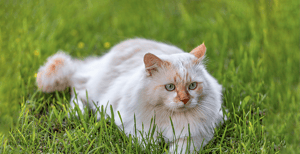
Some cat breeds are almost indistinguishable. The spirited and very active Turkish Van, on the other hand, is clearly recognizable by its light coat and completely different coloured bushy tail.
Turkish Van profile
- Size large
- Weight cat: approx. 5.5 kg, tomcat: approx. 7.5 kg
- Origin Turkey
- Build long, very strong
- Coat length semi-long
- Coat color white with color on head and tail
- Coat care medium
- Behavior spirited, playful
- Character intelligent, curious
Appearance and character of the Turkish Van
The Turkish Van is a pure breed that is said to have existed for 2000 years. It has always had a white body with a few spots on the head. The tail is usually brownish with pale rings. Depending on the breeding association, the color of the head and tail may also be cream, reddish-brown, blue, tortie or black. This striking two-tone coloration is the trademark of this medium to large cat breed. Fittingly, it occasionally happens that animals are born with two different eyes. One is blue, while the other is green, amber or orange. These stand out particularly well in the light-colored coat. Although the breed is densely coated, it has no undercoat. Their entire coat, which is quite voluminous on the neck, chest, shoulders and hind legs, especially in winter, consists exclusively of topcoat.
The Turkish Van has a very interesting character: it is not a wallflower, but knows exactly what it wants and how to get it. This intelligent cat breed encourages play, loudly calls attention to mealtimes or snuggles up when it thinks it's time for a cuddle. It is assertive, spirited and playful, which makes children in the household happy. She is also quite stress-relevant, curious and active. Although she should not miss out on sleeping phases, she will certainly not be bored.
Turkish Van: keeping and care
Turkish Van cats are curious and active. They would therefore have no objection to safe outdoor access . But they can also manage without it. As they lack social contact in this case, they would be happy to be kept in pairs. For example, wild chases through the apartment are more fun than with two-legged friends. However, no Turkish Van would want to do without us. Their relationship with their owners is often very close, which is why they don't like to be left alone at home for long periods of time . She wants to be part of her owner's life and enjoys playing together and being stroked. She should also be provided with a varied scratching post, scratching boards and toys. This will keep the clever cat breed mentally challenged and wonderfully occupied.
Grooming is less complicated than it might seem. Although the Turkish Van has a rather luxuriant coat, especially in winter, fortunately this is only long top coat. Without an undercoat, there is little risk of the hair becoming matted. Nevertheless, it should be combed regularly. With a summer coat, combing once a week is sufficient; in winter, twice is better. If the coat is due to change , it may be three times, as this prevents the cat from swallowing too much hair, which could cause a problem in the gastrointestinal tract.
Nutrition
Whether kitten, adult cat or senior - the food for a Turkish Van should always be of high quality and adapted to its age . Cats are carnivores by nature, so the cat food should contain a high proportion of meaty ingredients. Sugar, flavor enhancers and artificial colors and preservatives should not be added to the food.
animonda offers the right food for every stage of your cat's life. Choose between kitten, adult and senior food. The products are specially formulated to meet the particular nutritional requirements of the different life stages of cats. This creates the best conditions for a healthy and long cat life.
Health of the Turkish Van
The Turkish Van is a rare breed of cat. There is therefore an increased risk of inbreeding, which can result in immunodeficiency diseases and a shortened lifespan. When buying this breed, care should be taken to purchase animals only from a trustworthy and responsible breeder.
Breed-typical diseases can be associated with their white coat. The reason for this is the mutation of the pigment genes that lead to the color white. This is associated with an increased predisposition to blindness, hearing loss or eye tremors. A certain advantage is that the Turkish Van is not a pure white breed, but there are color parts on the head and tail. According to the breed standard, these parts should not make up more than 20 percent of the surface area.
As with the Turkish Angora, ataxia can also occur in the Turkish Van. This is a disability that can result in balance disorders in particular. Affected cats have an unsteady stance and can topple over when walking. The condition can be improved with therapy, but adjustments should still be made in the household. For example, a carpet makes walking easier than a smooth tiled or laminate floor. Stairs should be blocked off, litter trays should not have a high rim and bowls should be raised if possible.
History and breeding
There are many cat breeds that have been created by crossing different breeds. The Turkish Van, on the other hand, is a pure breed. It has not been and is not mixed with other cats. It is said to have existed in this form for 2000 years. Its origins lie in eastern Turkey, around the country's largest lake, Lake Van. It lies at an altitude of 1648 meters. In summer it can be a pleasant 28 degrees here, but in winter it is below zero. The Turkish Van has adapted to this and has a thick, long coat in the cold season.
There are repeated reports that the breed is in no way afraid of water. This may be due to Lake Van and its many tributaries. It is assumed that some cats have hunted for fish there or perhaps still do. This means for owners of these cats: It could be that the animals are not afraid of a full bathtub, aquarium or garden pond. It may be necessary to exercise a certain amount of caution here.
Unfortunately, there are no reliable figures on breeding in Turkey. It was great luck for the breed that the two Englishwomen Sonia Halliday and Laura Lushington made a trip through Turkey in 1955 and came across these animals. They were delighted with the cats and were allowed to take two specimens with them. From these two and two or three later imported animals, more or less the entire breeding outside Turkey was based. No more cats were allowed to be exported. This was even made a punishable offense.
It was not long before the breed was recognized by the British organization "Governing Council of the Cat Fancy". In 1960, the European umbrella organization Fife also officially accepted the Turkish Van. In 1882, the first animals were brought to the USA. In 1994, the Cat Fanciers' Association finally accepted the breed. Breeding should be assured for the time being, but the Turkish Van is still one of the rarest cat breeds.
animonda food for adult cats
Ocean Tuna + Seafood
Read More
Single Protein
Pure chicken
Country turkey, beef + venison
Read More
Beef + venison with cranberries
Mehr Erfahren
Tuna & chicken fillet mousse duo + prawns
Read More