

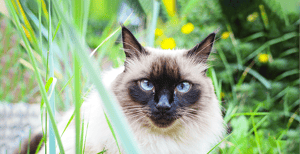
The Balinese is a long-haired variant of the Siamese cat. What they both have in common is their intelligence and curiosity. The cat breed is also known for its talkativeness and activity.
Profile Balinese
- Medium size
- Weight cat: approx. 3.5 kg, male: approx. 4.5 kg
- Origin Thailand
- Build long, slim
- Coat length semi-long
- Coat color light, with points
- Coat grooming medium
- Behavior talkative, adventurous
- Character intelligent, curious
Appearance and character of the Balinese
If you think Siamese cats are pretty and would like a cuddly long-haired variety instead of a shorthair cat, you've got it easy: the Balinese originated from the Siamese cat and has almost exactly the same breed standard. The only difference is the coat length. The Balinese has a semi-long coat with a bushy tail. The coat is fine, silky and has almost no undercoat. The basic color is whitish, and all kittens are born the same way. However, after a few months, the points slowly develop. These are colored areas of the body that affect the head, ears, paws and tail. They can be cream, fawn, cinnamon, seal, red, blue or chocolate in color.
The Balinese is of medium size, slender, elegant and sleek. Their head is slightly wedge-shaped, the ears large and pointed. In addition to their points, their deep blue eyes are particularly eye-catching.
One thing is certain: a Balinese will never be boring. They take an active part in their people's lives. She is very sociable, talkative and loves it when there is something going on in the house. She therefore has no problem with children, unless they annoy her. She likes to play games together and is also willing to learn tricks due to her intelligence. When she is exhausted, she is happy to have a cuddle together.
Balinese: keeping and care
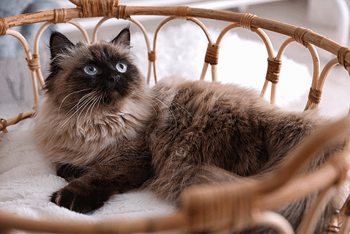 Balinese love company, so they are not suited to being kept alone for long periods. Ideally, they should be kept in pairs so that they don't get bored so quickly. But even then, you need to make sure you have enough time for your cuddly tiger. They love to play, be it with a cat fishing rod, smart toys or balls. Some even retrieve objects. If there is enough variety at home, they can do without going outside, but they are happy if they are provided with a cat-safe balcony or garden.
Although the Balinese is a breed with semi-long hair, it fortunately has hardly any undercoat. As a result, the hair has very little tendency to become matted. The shedding is also not as abundant as in a cat with an undercoat. Nevertheless, a lot of hair is shed, which is why it is worth combing your pet regularly - and not just during these phases. It is usually sufficient to use a comb or brush once a week. During the shedding period, the frequency should be increased so that the cat does not swallow as much hair when being washed.
Nutrition
Whether kitten, adult cat or senior - the food for a Balinese should always be of high quality and adapted to its age. Cats are carnivores by nature, so the cat food should contain a high proportion of meaty ingredients. Sugar, flavor enhancers and artificial colors and preservatives should not be added to the food.
animonda offers the right food for every stage of your cat's life. Choose between kitten, adult and senior food. The products are specially formulated to meet the particular nutritional requirements of the different life stages of cats. This creates the best conditions for a healthy and long cat life.
Balinese health
Balinese cats have a life expectancy of 15 to 20 years. This shows that they are basically a very healthy breed. Unfortunately, the gene pool is very small due to the small distribution. This can be associated with an increased incidence of hereditary diseases.
In order to produce healthy animals, responsible breeders have genetic tests carried out on all breeding animals and exclude diseased cats from breeding. Look for a reputable breeder who can prove their commitment with health papers.
Despite good health care, diseases can occur. In the Balinese, these include hypertrophic cardiomyopathy. This is a heart disease that causes a thickening of the heart muscle. Gangliosidosis can also occur. This is a storage disease that leads to disorders in the brain. Symptoms include head tremors and restricted mobility.
History and breeding
The name suggests that the Balinese originates from Bali, but this is incorrect. Its origins lie in Thailand, as is the case with the Siamese cat. They have been kept at the royal court and in temples for centuries. The Siamese is a short-haired cat, but occasionally there are long-haired kittens in litters. This was also the case when animals were occasionally exported to Great Britain and the USA in the 19th century. The breeders had no interest in these cats, as they did not conform to the standard. Long-haired animals were simply sold to fanciers who had no interest in breeding.
It is not known how it came about that cats with long coats occasionally appeared in litters. It is possible that a Persian cat, for example, or another long-haired cat, was bred in intentionally or by mistake. A spontaneous mutation may also be responsible.
After many years of hardly anyone being interested in them, Marion Dorsey began pure breeding them in California in the 1950s. Initially they were called "long-haired Siamese cats", but to avoid confusion, the decision was made to change the name. Balinese dancers with their graceful movements provided the inspiration for the name Balinese. The breed gained official recognition in the USA as well as in the European umbrella organization FIFé in 1983. Unfortunately, it never really made the breakthrough, which is why it is a rare breed that is more difficult to obtain.