

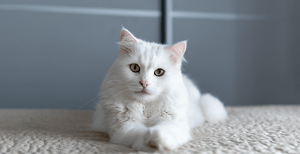
This long-haired beauty from Turkey used to be reserved for sultans, but today everyone can enjoy it. However, it is not so easy to get hold of a purebred specimen of this rather rare cat breed.
Turkish Angora profile
- Size medium
- Weight cat: approx. 3.5 kg, tomcat: approx. 4 kg
- Origin Turkey
- Build slender, graceful, supple
- Coat length semi-long
- Coat color all (no points)
- Coat care low
- Behavior playful, affectionate
- Character curious, uncomplicated
Appearance and character of the Turkish Angora
Until the last century, the Turkish Angora was only available in solid white. However, due to the associated health risks, it was decided to abandon this. Today, the breed standard states that all colors are permitted , with the exception of points. The Turkish Angora is available in solid white, red and black. It is also available in two or three colors, with points or patterns. There is something for every taste. However, there is no short-haired version. But the beautiful long hair is one of their trademarks. It is very fine, with a silky sheen and can be a little wavy. The Turkish Angora has no undercoat, but still makes a very imposing impression due to its ruff and luxuriant tail. Its body has good proportions , it moves gracefully and smoothly, has slightly longer hind legs than front legs and a relatively small head. Their ears and almond-shaped eyes are large, however.
The Turkish Angora is not only beautiful, but also has a very pleasant nature: It is uncomplicated, alert and loves to cuddle. On the one hand, she is very affectionate, but the next moment she seems to have bumblebees up her butt and is eager to play and run around the apartment. As she is also quite talkative, it's hard to get bored with her.
Keeping and care
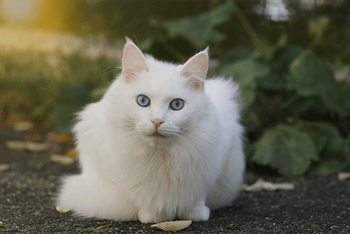 Living with a Turkish Angora is easy. It doesn't make any special demands. There is only one thing she doesn't like - having to be alone all the time. If this happens regularly in a household, it is best to get two animals at the same time . They can pass the time together while they wait for their owners. As they are very people-oriented, even with two animals there should be enough time for cuddles together every day. This is important for them and they may demand it insistently. The same can happen when they are in a playful mood. In this case, you should reach for the play rod or other activities and enjoy the time together with them. A ceiling-high scratching post is beneficial in this context. This is perfect for racing up and down. It also provides the perfect view and, if desired, an undisturbed retreat. They do not need a run if there is enough variety in the household. But there are certainly some that know how to enjoy it.
Grooming is less complicated than it may seem at first glance. Although the Turkish Angora has a semi-long coat, there is no undercoat underneath. The advantage of this is that the coat does not become matted so quickly. In addition, the amount of hair is less than in a Persian cat, for example. Nevertheless, the coat should be combed regularly, especially during the shedding period. This is a welcome support for the cat. It also reduces the risk of the cat swallowing too much hair, which could cause a problem in the gastrointestinal tract .
Nutrition
Whether kitten, adult cat or senior - the food for a Turkish Angora cat should always be of high quality and adapted to its age. Cats are carnivores by nature, so the cat food should contain a high proportion of meaty ingredients. However, sugar, flavor enhancers and artificial colors and preservatives should not be added to the food.
animonda offers the right food for every stage of your cat's life. Choose between kitten food,adult food and senior food. The nutrients are specially adapted to the cat's age. This creates the best conditions for a healthy and long cat life.
Health
The greatest risk of possible illness is with pure white animals. This applies not only to this breed of cat, but to cats in general. The reason for this is the mutation of the pigment genes that lead to the color white. This increases the predisposition to hearing loss or blindness. This fact was also the main reason why the breed standard was adapted at the end of the 20th century and white was no longer the only coat color permitted.
In order to produce healthy animals, responsible breeders have genetic tests carried out on all breeding animals and exclude diseased cats from breeding. Look for a reputable breeder who can prove their commitment with health papers.
Despite preventive health care, diseases can occur. One of these is ataxia. This is a disability that mainly results in balance problems . The cat has an unsteady stance and can fall over when walking. There are different forms of ataxia and correspondingly different forms of therapy. It is often possible to improve the condition, although adjustments in the household are usually unavoidable. These include, for example, that a carpet makes walking much easier than a smooth tiled or laminate floor. Stairs should be closed off, litter trays should not have a high rim and bowls should ideally be raised.
History and breeding
The Turkish Angora is a very old breed of cat. The first mentions date back to the 15th century. It is even associated with Mohammed and Mustafa Kemal Atatürk, the founder of the Turkish state. Some believe that he could be reincarnated as an Angora cat. The Angora cat has not only become the national cat, but has always been something very special. In the past, only sultans were allowed to keep them and there was a strict export ban. Exceptions were only made when the cats were given as gifts to European royalty. Lovers of the breed included King Louis XV and Marie Antoinette, Queen of France.
As export restrictions were increasingly relaxed, the animals were highly sought after by aristocratic families. After all, there was a shorthair cat on every corner, but not animals with such a beautiful long coat. However, this changed in the 20th century. As a result, interest declined rapidly and the zoos of Istanbul, Izmir and Ankara agreed on a joint breeding program to save the breed. However, their main interest was in white animals, which made breeding more difficult and more susceptible to disease. Fortunately, interest groups in England and the USA took a more generous view and had good success.
In 1970, the breed was recognized by the American Cat Fanciers' Association. The European umbrella organization FIFé followed in 1988. Similarities with the Turkish Angora include the Maine Coon, Norwegian Forest Cat and Siberian Cat. However, they are all larger and heavier. The difference to the Persian cat is that it has a rounder shape.