

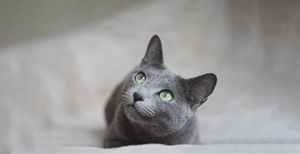
At first, the Russian Blue is a little reserved, but as soon as she has gained confidence, you have to expect everything from her: Sometimes she wants to play together, then cuddle and then simply sleep in peace.
Profile Russian Blue
- Size medium
- Weight cat: approx. 3.5 kg, tomcat: approx. 5 kg
- Origin Russia
- Build elongated, elegant
- Coat length short
- Coat color blue-grey
- Coat care low
- Behavior calm, playful
- Character affectionate, stubborn
Appearance and character of the Russian Blue
It is actually unmistakable, but you have to know exactly what to look out for. It can be confused with the blue-grey Carthusian, the Korat and the blue version of the British Shorthair. However, the latter has a rounder shape and the Korat has no undercoat. Only the Russian Blue has a double coat in combination with green eyes. Although the coat is short, it is very dense and plush. This is because their undercoat is just as long as their top coat. As a result, the entire coat stands out a little. When stroking it, you can see how soft and silky it is. If you look at it against the light, you can see a silvery sheen. This is due to the fact that the tips of the hair are colorless, which causes the light to be refracted.
The breed standard not only requires a clear silver shimmer, but the coat should also be as uniformly blue-grey as possible. A long body, graceful growth, high legs and a tapered long tail are also desired. The eyes must be green, the ears not too small and the nose blue-grey. In principle, the body should be visibly different from the oriental and a stocky, roundish type.
The character of the Russian Blue is extremely interesting. At first, it appears to be aloof. But suddenly it may stroke the visitor's legs or make itself comfortable with him. She just needs some time. As soon as she gains trust, she turns into an affectionate cuddly cat. However, it is difficult to predict how long this phase will last. Suddenly, she may retreat back to her scratching post or be desperate to play. This changeable behavior must always be reckoned with. Most people find this exciting and fascinating, but some might prefer a cat that is not quite so headstrong.
Russian blue: keeping and care
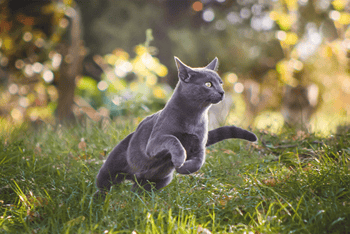 The Russian Blue does not have any unusual husbandry requirements. However, it is not completely uncomplicated. Sometimes it is a little moody and wants this, then that. It is quite possible that it will make this known by meowing. After a while you know exactly what she wants. Perhaps the usual feeding time has already passed, she wants to play together or wants more attention. Although it is important for her to have an undisturbed place to retreat to, she is reluctant to accept a delay if she feels like spending time together. It is therefore ideal to keep two cats. This avoids a single cat being alone when no one else is at home. They may accept this for a while, but it could become difficult in the long term. In this case, you should consider whether outdoor access via a cat flap is possible. However, the traffic situation should be acceptable for this. It also makes sense to check with your vet whether certain vaccinations and precautions against parasites need to be taken. In any case, there should be sufficient variety in the form of games, cuddly caves and an interesting scratching post for the intelligent animals in the home.
Due to the Russian Blue's fluffy coat and undercoat, it might be assumed that it sheds a lot and that grooming is relatively time-consuming. Fortunately, this is not the case. On the contrary: the hair grows so densely that dead hair only falls out insignificantly. This fact makes the breed interesting for allergy sufferers. However, there is no guarantee with any cat breed. In the case of the Russian Blue, grooming is limited to combing once a week. Then it shines even more beautifully. If the coat is due to be changed twice a year, grooming should be more intensive. Most animals don't have a problem with this, but enjoy it when they have full attention.
Nutrition
Whether kitten, adult cat or senior - the food for a Russian Blue should always be of high quality and adapted to its age. Cats are carnivores by nature, so cat food should contain a high proportion of meaty ingredients. Sugar, flavor enhancers and artificial colors and preservatives should not be added to the food.
animonda offers the right food for every stage of your cat's life. Choose between kitten, adult and senior food. The products are specially formulated to meet the particular nutritional requirements of the different life stages of cats. This creates the best conditions for a healthy and long cat life.
Health of the Russian Blue
The Russian Blue is a naturally evolved breed of cat. In general, this means that the likelihood of hereditary diseases is lower than in man-made breeds. This also applies to the Russian Blue. It is a fairly robust, healthy cat breed. However, the gene pool is not particularly large. It is therefore important to buy an animal from a responsible breeder. Here you can be sure that the breeder has regular genetic tests carried out and only breeds perfectly healthy cats. Although there is still a residual risk, it is significantly lower.
History and breeding
As the name suggests, the Russian Blue originates from Russia. The first mentions come from the northern port city of Arkhangelsk. Winters here are icy cold, which explains the breed's thick, double-layered coat. Unfortunately, this was its downfall when the Vikings became aware of the Russian Blue. They turned them into fine fur collars. But times were not always so cruel. On the contrary: from the 18th century onwards, it became an increasingly coveted object at court. The Russian Tsar Nicholas I loved the breed and surrounded himself with these animals. He occasionally gave individual specimens as gifts, for example to the Queen of England. Her son, Edward VII, was so enthusiastic about the Russian Blue that he even took over the chairmanship of a newly founded cat association.
As with many other cat breeds, the two world wars were a difficult time for the Russian Blue. Breeding efforts came to a complete standstill in some cases. Due to a lack of animals, other breeds such as Siamese, British and European Shorthair were sometimes crossed in. As a result, however, the typical coat of the Russian Blue was increasingly lost. As a result, some breeders tried to reverse this in different ways, which led to different types. Today there is an English, Scandinavian and American form of the Russian Blue. With a large gene pool, it is not advantageous to draw strict boundaries here.
The Russian Blue was officially recognized for the first time in 1937 and was recognized by the European umbrella organization FIFe in 1949. Although there have been isolated efforts to breed white and black variants for some time, only blue-grey has been permitted to date. Ideally, the coat should be a medium blue-grey with a silver sheen. And of course, due to the equal length of the undercoat and top coat, it must stand up like a plush coat. The difference to other cat breeds is so clear that you could recognize a Russian Blue blindfolded.