

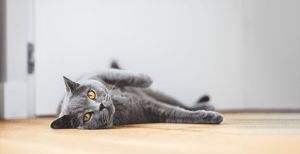
Originally, the British Shorthair was a normal domestic cat. However, various crossbreeds changed both their appearance and their nature, which became calmer and more affectionate.
British Shorthair profile
- Size medium
- Weight cat: approx. 4.5 kg, male cat: approx. 6 kg
- Origin Great Britain
- Physique muscular, stocky
- Coat length short, dense
- Coat color varied
- Coat grooming medium
- Behavior gentle, calm
- Character uncomplicated, adaptable
Appearance and character of the British Shorthair
The British Shorthair is the epitome of a cuddly cat. It is the perfect role model for fluffy cats, because there is nothing angular and angular about it, everything is round: large saucer eyes, round head, rounded ears and a body with gentle curves from front to back. It is also fitting that she has both short legs and a short tail. Everything about her looks compact, but definitely massive and strong. It is the opposite of super-slim cat breeds such as the Oriental Shorthair or the Sacred Burmese. With her you have something to touch - and something very cuddly. Their coat is a dream: it is short and dense, but does not lie flat. On the contrary: a dense undercoat ensures that the coat stands out. The breed standard states that "the texture should feel grippy". And this is exactly what you can feel if you are lucky enough to cuddle a British Shorthair.
Many people associate the British Shorthair with the color blue, which refers to a uniform gray. However, the BKH comes in a wide variety of colors. It starts with solid white and goes through fawn, cinnamon, cream, red, purple, chocolate and blue to black. Bicolored and tricolored animals are also permitted, as are patterns and dots. The breed standard is also generous when it comes to eye color: whether green, copper or blue - or even odd eyed - i.e. one eye blue, the other copper - anything is possible. In total, there are said to be over 300 color variations in the BKH.
As different as the colors are, as different can be the nature of the British Shorthair. Some breeders have the impression that certain coat colors are associated with special character traits, but this is unlikely to be the case. Overall, the BKH is a rather quiet, reserved cat breed. It likes to be cozy, but has a thick coat in the truest sense of the word, which is why it is also quite stress-resistant. She adapts to her home and loves to be stroked and cuddled. They also have a gentle disposition and love to play, although most don't overdo it.
British Shorthair: keeping and care
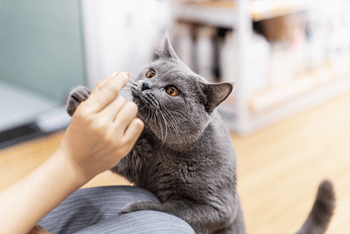 Life with a BKH is generally quite relaxed. They are neither particularly loud nor above-average or demanding. They love to be cozy, which is why there should be enough comfortable places in the household. It likes to look down from high up on a scratching post, observe its surroundings from a window sill or a cat-proof balcony or loll comfortably on the sofa. This is downright infectious, and a cuddle session should not be missed. But remember to encourage a particularly lazy cat to play regularly, otherwise it could put on weight. This is not so easy to see under the fluffy fur. If you are not sure, you should weigh your velvet paws occasionally and, if necessary, reduce the treat ration and provide exercise.
Most British Shorthairs do not have a free run. This is not a problem for cats that are used to being kept indoors. In this case, however, it is an advantage if two animals are kept and you spend time with them every day. Cats do sleep a lot, but too much boredom is bad for the mind. Two conspecifics can always interact with each other and it is not so bad if they occasionally have to be left alone.
Although the British Shorthair is one of the breeds with a short coat, they do have a lot of undercoat. This ensures that significantly more hair is shed when changing their coat than with other shorthair breeds. Cats should be combed at least once a week to brush out dead hair. Fortunately, despite the undercoat, there is hardly any tendency for the coat to become matted. It is too dense and sticking out for that. Nevertheless, grooming should be intensified a little more during the shedding period so that the cats do not swallow too many loose hairs when being washed.
Nutrition
Whether kitten, adult cat or senior - the food for a British Shorthair should always be of high quality and adapted to its age. Cats are carnivores by nature, so the cat food should contain a high proportion of meaty ingredients. Sugar, flavor enhancers and artificial colors and preservatives should not be added to the food.
animonda offers the right food for every stage of your cat's life. Choose between kitten, adult and senior food. The products are specially formulated to meet the particular nutritional requirements of the different life stages of cats. This creates the best conditions for a healthy and long cat life.
British Shorthair health
British Shorthair cats do not have any noticeable hereditary diseases. They are considered a healthy and robust cat breed. However, this does not mean that they cannot become ill. To keep the risk as low as possible, responsible breeders have all recommended vaccinations, preliminary examinations and any recommended genetic tests carried out. This includes a DNA test for hypertrophic cardiomyopathy (HCM), a common heart disease in cats. In the early stages, this can be treated well with medication. It is also advisable to test kittens for the kidney disease Polycystic Kidney Desease (PKD). If an animal is diagnosed with this hereditary disease, it should be removed from breeding. Therapy is limited to treating the symptoms, as the disease cannot be cured.
History and breeding
Just like here, domestic cats have been welcome companions in England for centuries. Their job has always been to catch mice. The appearance of the cats played no role in this. However, in the 19th century, there was an increasing interest in breeding cats specifically in order to work out certain characteristics. The starting point for this were normal domestic cats, as we still find them today in pure breeding in the European Shorthair. Mating with the Russian Blue and Siamese brought about the first changes. These could all be admired at a cat show in London in 1871. The winner was a blue tabby British Shorthair.
All of a sudden, the cat breed was on everyone's lips. However, the turmoil of the two world wars significantly reduced interest in breeding and made it increasingly difficult. Due to a lack of animals, Carthusian and Persian cats were occasionally crossed. This led to further changes in appearance. The cats became stockier, fluffier and acquired their round shapes. As soon became apparent, this made the British Shorthair even more popular than it already was before the wars. People liked this change in type. But it also brought problems.
Until the 1970s, the breed had a common standard with the European Shorthair. But the changes were so drastic that the umbrella organizations decided to separate the breeds. This was certainly the right thing to do, because if you look at a normal domestic cat today and compare it with a typical British Shorthair, the differences are striking. The BKH has developed into a fluffy cuddly cat and is regularly among the top 5 in the popularity rankings.