

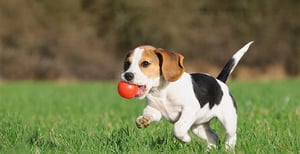
Retrieving is a perfect activity for dogs. In contrast to throwing sticks, there are a few rules here. These ensure that there is real cooperation between humans and dogs.
Retrieving is not throwing sticks
Some dog owners occasionally throw a stick and are happy when the dog brings it back. But it can just as easily happen that the dog disappears with the stick, simply leaves it lying around or doesn't want to give it back when it returns. This does not happen with "real" retrieving. There are clear rules here, which may come as a surprise at first - especially to the dog. But if you train and stick to them, you can gain a lot of positive benefits. They will have a reliable companion at their side who has learned not to chase after every moving object.
Practicing retrieving with your puppy
Some puppies show an early interest in carrying all sorts of things around in their mouths. As dogs need to be kept busy, it is a good idea to practise fetching with them in a playful way. But remember that puppies still have a very short attention span and there is no point in forcing them to do anything. You could risk taking away their desire to fetch. You can start by praising and rewarding carrying or fetching. If this involves the beloved slipper, then it is advisable to take it back without saying a word. Scolding could disrupt the entire retrieving process. If, on the other hand, he retrieves something permitted, praise him effusively and offer him a treat in exchange for his prey.
Encouraging dogs to fetch
Not every dog is interested in fetching. It could be that he really doesn't want to do it and would rather do something else with his owner. But it could just as well be that sufficient motivation is needed first. On the one hand, this depends on you: With some dogs, you have to work really hard. Make the object interesting for the four-legged friend. Hide it behind their back, wag it back and forth in front of them and try to get them excited about it with words. If this doesn't work, get a food dummy. You can hide treats in this small bag. The dog will smell it, which is why he is likely to be more interested in the food bag than in a stick or toy.
How do I teach my dog to fetch?
- Filling a treat bag
The easiest way to teach a dog to fetch is with a food pouch. You can buy these in any pet store or online. Fill the bag with your dog's favorite treats. This should lead to a high level of interest in the food dummy. - Choose the right time and place
If you want to try it without a food bag, it is all the more important to choose the right place and time for training. The dog should already have been given the opportunity to get loose and exercise a little. It is also an advantage if he is not full to bursting and is therefore more interested in being rewarded with treats for a certain behavior. Also remember that other dogs and people could disturb his concentration. The fewer distractions there are, the better the first steps in retrieving will work. - Arouse interest in the object
Most dogs love treats. Particular interest in an object can therefore be aroused if it not only smells delicious but also has a reward hidden inside. This is given when the dog demonstrates reliable retrieving step by step. Initially, however, it is simply a matter of the four-legged friend picking up the object. If he gives it back, he either gets a reward directly from it or receives a treat from another food bag in exchange. - Bringing the object back reliably
To practice retrieving, you should not throw the object several meters away, but one or two meters will suffice. This will help you to maintain contact with your dog and call it back immediately. If this does not work, put him on a lead. Of course, you should not yank on the lead if he tries to escape, but you can stop him from running away. Lure him back to you and reward him for doing so. - Only start running on command
One of the biggest differences to normal throwing is that the dog is not allowed to run off immediately or even beforehand, but instead waits dutifully next to you. A lead can also be an advantage at the beginning. The dog should also already know the commands "sit" and "stay". Because that's what the first step is all about. Ask him to do this and make sure that the dog is focused on you. Throw the object away rather casually and make sure that he keeps the "Stay" command. This is an important exercise for what is known as the stay command. This means that a dog does not simply run off because something moves somewhere. The dog should internalize that this behaviour is only tolerated if there is a command for it. This could be "fetch" or "retrieve", for example. Only then do you allow the dog to fetch the object. - Handing over the dummy food
With the reliable waiting, picking up and returning of the dummy food or another object, three decisive steps have already been taken. At the beginning, each of these points should be praised and, depending on progress, always rewarded. Finally, however, a reward should only be given when the dog dutifully places the object in front of the owner or even drops it into the owner's open hand. This completes the process and you can start again. It's a great feeling when this slowly but surely works more and more reliably. This is the perfect way to keep your dog mentally and physically occupied. - Increase the difficulty level
There are several ways to increase the level of difficulty when retrieving: Firstly, you can throw the object further and further, also increase the period of standing still or practise retrieving in tall grass. This means that the dog no longer has to use its eyes to retrieve the object, but has to use its nose. If you want to go one step further, you can use a second food dummy and let the dog collect first one and then the other. Or does your dog have lots of toys at home? With a little practice, you can get him to collect them in the evening. This saves you work and keeps your dog busy at the same time.
Instructions in the video
Would you like to watch a video on retrieving? Animal trainer Fränzi Lüttich shows how it works with her dachshund Polly:
Please accept the marketing cookies to watch the video.
-1.jpg?width=300&name=82931_GranCarno%20Meat%20Chunks%20Huhn%20pur%20Medium-Maxi%2080g%202024_72dpi_1920x1920%20(1)-1.jpg)
_1920x1920%20(1)-2.jpg?width=300&name=82932_GranCarno%20Meat%20Chunks%20Rind%20pur%20Medium-Maxi%2080g%202024_72dpi_(1)_1920x1920%20(1)-2.jpg)
_1920x1920%20(2)-2.jpg?width=300&name=82929_GranCarno%20Meat%20Chunks%20Lamm%20pur%20Small%2060g%202024_72dpi_(1)_1920x1920%20(2)-2.jpg)
-1.jpg?width=300&name=82930-animonda-GranCarno-Adult-Meat_Chunks-Pute_pur-Hund-Snacks.jpg_1920x1920%20(1)-1.jpg)