

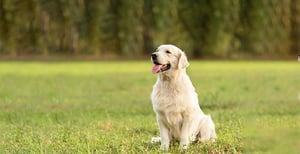
Sit is one of the most important commands a dog should know. The easiest way to teach him to sit is with a treat that is held over his head and led backwards. We will show you how to proceed step by step.
Why do I need the "sit" command?
Every dog should know "sit" because this command is often needed in everyday life. For example, it can be useful to have your dog sit briefly before crossing the road. It also makes the situation much easier if you want to put your dog on a lead in peace. It is also very pleasant if the dog sits obediently next to you when you have to queue somewhere , wait for something or have a short conversation with someone on the sidewalk.
It can also take the dog's mind off things and calm him down if he gets into a stressful situation and hears the command from his owner. If the dog has learned to "sit" over a greater distance, it may also prevent it from running away if it follows a trail and there is a risk that it will run away immediately.
How do I teach the dog to sit?
A dog must be able to understand what you want him to do. That's why every command should make sense and be broken down into individual steps. The best way to teach your dog to sit is as follows:
- Have treats ready
There is no better motivation for most dogs than treats. These should rarely be given just for fun. There are a variety of ways to use them in short training sessions every day. Some are better received, others less so. For training, it should be the tastiest treats, as this will keep their attention particularly high. But remember not to overdo it. If the amount of treats is very generous, the daily food ration should be somewhat smaller. - The time and place should be right
Dogs like to be distracted, especially when they are puppies. When practicing a new command, the environment should be as stimulation-free as possible - so preferably no other dogs in the vicinity. It is also an advantage if the dog has been able to let loose and let off some steam. This is a good time to get his attention. - Take a treat in your hand
Call the dog over or go to him. Show him that you have a treat in your hand and attract his interest. Stand directly in front of the dog, hold your hand over its head and slowly move it backwards. The dog will raise its head and, if it doesn't go any further, will most likely slowly lower its rear end. You can give him the treat now or, if it is clear that he is about to sit down, wait for the moment. The important thing is not to wait a few seconds because you think it will work just fine. If he only gets the treat when he is already standing up again, he could combine the reward with the "stand up" action. - Verbal command and visual cue
Initially, you should say the "sit" command exactly when the dog touches the ground with its hindquarters. This way he knows exactly what is being rewarded. Later on, the command is used to ask the dog to sit. Ideally, you should also introduce a visual cue at an early stage. Most people opt for an upwardly stretched index finger. On the one hand, this is very pleasant when a dog responds without you having to call out loudly surrounded by several people, for example, and on the other hand you should think about later. If a dog can no longer hear well in old age, visual signals are very valuable. - Practice and increase requirements
You should never demand too much from a puppy. The attention span of young dogs is very short. It can be over after just one or two minutes. Be happy when you see the first signs and keep at it. Plan three to four short learning sessions per day. It works better and better over time. Then you can start to increase the challenge a little by having the dog sit for a longer period of time or by giving the command over a greater distance. - Don't forget the release command
The first few times, you will certainly be satisfied if the dog simply does what it is supposed to do when given the sit command, namely sit down. Then a treat, joy and praise are the order of the day. Soon, however, a release command, such as "Okay", should also be given. The dog then knows when the command is finished for him - perhaps after a few seconds, but possibly only after one or two minutes. A longer sit can be very helpful when out and about or at the dog park.
Video about the "Sit" command
Would you like to watch a video of the "Sit" command? Animal trainer Fränzi Lüttich shows how it works with her Weimaraner dog Sky:
Please accept the marketing cookies to watch the video.

_1920x1920.jpg?width=300&name=82929_GranCarno%20Meat%20Chunks%20Lamm%20pur%20Small%2060g%202024_72dpi_(1)_1920x1920.jpg)
_1920x1920.jpg?width=300&name=82932_GranCarno%20Meat%20Chunks%20Rind%20pur%20Medium-Maxi%2080g%202024_72dpi_(1)_1920x1920.jpg)