

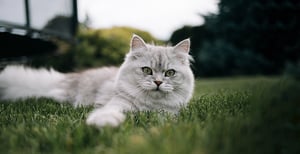
The British Longhair evolved from the British Shorthair and has almost exactly the same breed standard. Both are calm, uncomplicated cat breeds. The only difference is their coat length.
British Shorthair profile
- Size medium
- Weight cat: approx. 4.5 kg, male: approx. 6 kg
- Origin Great Britain
- Physique muscular, stocky
- Coat length well coated
- Coat color varied
- Grooming time-consuming
- Behavior gentle, calm
- Character uncomplicated, adaptable
Appearance and character of the British Longhair
The British Shorthair is already a real cuddly cat with its luxuriant undercoat. However, it is surpassed by the British Longhair, which has even more fur. It is only short on the face, otherwise it should be semi-long to long according to the breed standard. The British Longhair has a beautifully developed ruff, a well-coated tail and a very dense coat on the body. The undercoat is plush and gives the coat an impressive volume. Depending on the season, there may be slight changes in length and density.
Apart from the coat length, British Longhairs and Shorthairs have the same breed standard. In terms of build, they are muscular and slightly stocky. Legs and tail are rather short, which also applies to the nose and ears. The eyes, on the other hand, are large and may be green, blue or copper-colored. Two different eye colors are even permitted - for example, one eye copper, the other blue.
The coat color of the British Longhair is extremely diverse. There are over 300 color varieties - including solid white, creamy red, blue, chocolate and black. Two- or three-colored animals are also permitted, as are spots, various patterns or stripes on the legs.
The fact is that the British Longhair is a rather calm breed of cat that likes to take it easy. It seeks close contact with its family, loves to cuddle together and is not easily disturbed. It is rather averagely playful and not overly temperamental.
British Longhair: keeping and care
Life with a British Longhair is very pleasant and uncomplicated. They are one of the more reserved cat breeds that are neither loud, demanding nor moody. It is important for them that everyone gets along well and that they are looked after properly. She is very affectionate and wants to be looked after. There should therefore be enough time for cuddles together every day. Cozy places are also important to her, for example on the lying surface of a scratching post or on the windowsill with a view outside. As with the related Persian cat, they should not be allowed to run free. The result would be that after an excursion in the great outdoors she would return with all kinds of greenery and undergrowth in her fur. It is easier to offer her a varied home. This is best achieved with a conspecific at her side with whom she can play and cuddle. Cat toys should also be available to provide physical and mental variety.
The British Longhair requires more grooming than the BKH. It has a plush undercoat and semi-long to long hair. The coat is dense, double and sometimes very voluminous. It is therefore advisable to comb through the coat several times a week with a coarse comb. If you let this slide, you must expect tangles to form. Such tangles can be detected by running your fingers through the coat and pulling it. Ideally, grooming should begin in a playful way at kitten age. This makes grooming all the more likely to be seen as something completely normal and can then be carried out later without any problems. This is particularly important during the shedding period, when BLH sheds large amounts of hair. The more that is combed out, the less will fly around the household and be swallowed by the cat during its daily cat wash.
Nutrition
Whether kitten, adult cat or senior - the food for a British Longhair should always be of high quality and adapted to its age. Cats are carnivores by nature, so the cat food should contain a high proportion of meaty ingredients. Sugar, flavor enhancers and artificial colors and preservatives should not be added to the food.
animonda offers the right food for every stage of your cat's life. Choose between kitten, adult and senior food. The products are specially formulated to meet the particular nutritional requirements of the different life stages of cats. This creates the best conditions for a healthy and long cat life.
British Longhair health
British Longhair cats have no conspicuous hereditary diseases. They are considered a healthy cat breed. It is to be hoped that this will remain the case, as the breed's gene pool is relatively large and breeders must therefore be careful. To keep the risk as low as possible, responsible breeders have all recommended vaccinations, preliminary examinations and recommended genetic tests carried out. This includes a DNA test for hypertrophic cardiomyopathy (HCM), a common heart disease in cats. In the early stages, this can be treated well with medication. It is also advisable to test kittens for the kidney disease Polycystic Kidney Desease (PKD). If a cat is diagnosed with this hereditary disease, it should be removed from the breeding program.
History and breeding
The starting point for the British Longhair was normal domestic cats. In the 19th century, they were deliberately bred to other breeds, including the Russian Blue and Siamese. These resulted in the first changes, which visitors were able to admire at the world's first cat show in London in 1871. The winner was a blue tabby British Shorthair. It provided the breed with its first surge in popularity. However, the two world wars reduced interest in breeding and made it increasingly difficult. Due to a lack of animals, breeders occasionally crossed with Carthusian and Persian cats. This resulted in the cats becoming stockier and fluffier. People liked this change in type. Therefore, it was intensified in this direction. The result was the British Longhair as we know it today, with its soft curves and particularly dense, erect coat.
Although breeding was promoted with the help of Persian cats, the dominant shorthair gene prevailed in the majority of the offspring. The coat was therefore luxuriant, but not long. Occasionally, however, a kitten with long hair was found in a litter. This was sorted out, neutered and passed on to fanciers. However, the breeders repeatedly received responses asking why they did not also breed long-haired animals, as these were at least as pretty as the short-haired variety. This led to breeding efforts being made specifically with long-haired animals. The prerequisite for this is that both parents carry the long-haired gene. At the beginning of breeding, these were often random products, but it is now possible to analyze the gene key of the cats in a binding manner. As a result, it is now possible to breed purebred cats with certainty.
Cat associations around the world do not agree on whether the British Longhair should be regarded as an independent breed or whether it is merely a coat variant. In 2017, the European umbrella organization FIFe decided to recognize the BLH as a separate breed.