


If you discover a tick on your dog, you should remove it as quickly as possible. This will reduce the risk of disease transmission. It is best to use special tick tweezers to remove the tick. We explain step by step how you should proceed.
What do ticks look like?
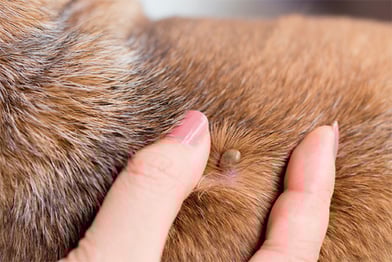 Ticks are on average 3 to 6 millimeters in size. However, a blood-sucking tick can reach a length of almost three centimetres. On the other hand, there is also the larval stage of a tick. These tiny parasites are just the size of a pin and are difficult to spot in a dog's coat. There are slight variations in color depending on the tick species. The most common species that infests dogs is the common wood tick (also a carrier of Lyme disease). It is black with a brown hind body. The brown dog tick is uniformly brown, and the alluvial forest tick (carrier of babesiosis) is slightly marbled.
Which ticks are dangerous for dogs?
In principle, every tick poses a potential danger . Unfortunately, nobody knows the history of a tick. Ticks steal tiny and completely insignificant amounts of blood from the dog. However, during the blood-sucking process, any pathogens that may be present can be transmitted from the tick to the dog.
From development from egg, larva and nymph to adult, the pests usually change hosts several times. If one of these hosts carries a pathogen, the tick can pick it up and may later transmit it to another animal.
When and where do ticks occur?
Ticks are thermophilic animals. This means that they cannot control their body temperature themselves, but adapt it to the outside temperature. At temperatures below 6 degrees they are not able to move. At higher temperatures, however, their bodies slowly come to life. They prefer warm temperatures of around 20 degrees in a rather shady, humid environment.
They are thereforeoften found from spring to fall in forests, bushy areas and in tall grass. There they lurk for their prey with all their senses. They can sense the slightest vibrations and can detect both the smell andCO2 emissions of their prey. If one passes by, they simply drop down or claw at it in a flash.
What helps against ticks in dogs?
One of the most important and effective means of combating ticks is to check your dog regularly. After a walk in the city you can usually save yourself the trouble, but the danger is always lurking in parks, woods and meadows. Fortunately, ticks first look for a suitable place on the dog's body. They prefer thin-skinned areas with good blood circulation and not too much fur. So if you start looking in good time, you have a good chance of deterring the bloodsuckers from their feast. Of course, this is easier with short-haired dogs than with long-haired dogs.
Which tick repellent is best for dogs?
There are various ways to protect dogs from tick bites and their possible consequences, such as Lyme disease, anaplasmosis or babesiosis. Unfortunately, there is no comprehensive vaccination, only protection against certain types of borrelia, which is why the Standing Veterinary Vaccination Commission does not have a general vaccination recommendation. Whether this is worthwhile should be discussed individually with the vet depending on the epidemiological situation.
One of the most commonly used products against ticks are spot-on preparations. The liquid solution is simply dripped directly onto the skin on the back of the dog's neck and then spread over the entire body. Spot-ons have a repellent effect - they generally prevent a tick from biting. The same applies to tick collars. In this case too, an active ingredient is spread on the skin, which, depending on the product, provides protection for several months.
Removing a tick from a dog
Despite all caution, it is often impossible to avoid finding a tick that has already bitten into the dog and started to suck blood. It is then important to react quickly and remove the tick from the dog completely. We recommend using special tick tweezers or a tick hook to remove the tick.
Important: Do not use any oil, nail varnish or glue before or when removing the tick, as the tick could release more saliva into the wound during its death throes, which could contain pathogens.
How to remove ticks reliably
- Strip the hair around the tick to the side so that you do not pull out any of your dog's hair.
- Place the tick tweezers as close as possible directly on the dog's skin.
- Once you have the head or front body under control, start pulling slowly.
- Twisting is generally not necessary!
- Gradually increase the pull and wait.
- The tick will normally come off after a few seconds.
- If not, be patient and support the pulling with gentle twisting movements.
- If the tick is torn apart, try to remove the rest with pliers or tweezers.
- Crush the tick between two solid objects or fix it in an adhesive strip that you can throw in the bin.
- If the tick's head remains in the skin, please observe the area closely and react as soon as you notice any inflammation.