

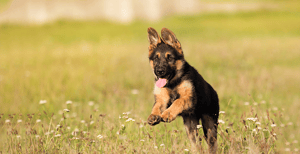
If your puppy bites your hand or nibbles on objects, you should stop him in good time so that he knows that he is not allowed to cross certain boundaries.
Biting experience in the first phase of life
From the 4th week of life, puppies start to become increasingly active and explore their environment. This also means that they show more and more interest in their siblings. They soon realize that they are a great way to pass the time. When they are not sleeping or eating, they play until they are exhausted. Chasing races and playful fights are particularly popular. Occasional bites are inevitable.
Initially, puppies are not yet particularly strong and their teeth are only just beginning to make their way out. However, from the fourth month of life, depending on the breed, the puppy loses its 28 milk teeth. Ideally, they should have learned bite inhibition by this time, as they will soon have extremely sharp teeth. Puppies experience this first-hand and also learn the reaction if they bite a sibling too hard, which makes them yelp and will most likely stop playing for the time being. This is extremely frustrating when you are in a playful mood , so over time puppies learn to take a step back and that their behavior has consequences. This prevents premature termination of play.
Bite inhibition must be learned
Not only do puppies need to learn a natural bite inhibition towards their siblings, this should of course also apply when living together with people. Bite inhibition is not innate, but only develops over time as a result of experience. If a puppy lacks this, for example because it was separated from its family far too early, it will lack self-assessment towards other dogs. The same applies if a puppy is raised in a kennel and has hardly any contact with people.
This is why it is so important to buy a dog from an experienced breeder. They use the time before their puppies move into a new home to familiarize them with all kinds of situations and noises. This includes, for example, everyday things such as vacuuming, driving, radio or television. But contact with different people, ideally from toddlers to senior citizens, should also be practiced early on.
Bite training with a puppy
Even if a puppy comes from a responsible breeder or has already been socialized by its siblings, it is important for humans and dogs to live together safely that you continue bite training with your young four-legged friend in its new home. This also includes bite inhibition, which it has certainly already learned to some extent, but which should now be worked on further.
If he is now suddenly allowed to chew on all objects or bite the hands of his humans, his previous experiences will be thrown overboard. Don't be too generous here, even if you don't mind too much at the moment. As soon as the dog is fully grown, you may want to change your mind. But then it will be difficult or impossible to get your dog out of the habitual and previously tolerated behavior.
Getting your puppy out of the habit of biting
If your puppy is constantly biting, you should establish clear rules as soon as possible. It is important that everyone in the household is in agreement. The dog cannot understand why it is allowed to bite its master's hand but not the children's. Your puppy must learn that its owner's skin is sensitive and that it can injure a person by snapping or biting. He will also not be able to tell the difference between a new and an old slipper, which he may chew on. It is best to only allow him to do this with his toys or tug toys. Everything else should be taboo and this should be made clear to the dog from the outset.
If he bites your trousers, slippers or hand, he must react immediately to make it clear that this is not allowed. Comment on the action with a clear "No" or "Off" and stop any play immediately. If he bites you on the hand, you can certainly "yelp" briefly and make it clear to him that this has hurt. Turn away and walk away from him. Some dog owners leave the room temporarily to send a clear signal. What you should not do is stop playing for just a few seconds while you may even commiserate with the puppy or talk him down. He might misunderstand or not understand this.
Educating puppies
Even if there are clear rules early on, there should never be more than a little spanking. Slapping or shouting is extremely negative for the dog and can disrupt the relationship. It is important that you use lots of praise when your dog does something right. Unwanted behavior, on the other hand, is commented on briefly and the dog is no longer paid attention to. If the guidelines are followed consistently by everyone in the household, success should be visible very soon. If not, don't wait too long to visit a dog trainer. Because the longer a (undesirable) behavior becomes ingrained in a dog, the more difficult it will be to get it out of the habit again.