

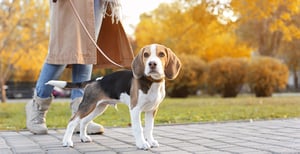
It is very pleasant when a dog is not constantly pulling on the lead. Unfortunately, the reality is usually different. We will show you how you can train your dog to walk on the lead step by step.
If your dog is constantly pulling
When you go for a walk, you sometimes wonder who is actually walking whom. Of course you should be considerate of your dog and let him sniff around and follow a trail for a few meters. But if the trail is definitely not on the planned route, then a dog has to accept that you are going in a different direction. It is also unpleasant if the dog constantly thinks it has to set the pace and pulls on the lead. On the one hand, this is understandable because a dog's natural gait is often somewhat faster than ours.
Some dog owners opt for a flexi lead because of this problem. Although this is unsuitable for training your dog to walk on a lead, it is an acceptable interim solution. It buffers the short trial breaks and the subsequent trot quite well, so that you can maintain your walking pace much better than with a short lead line. However, this only avoids a potential problem. If you really want to solve this, you have to use a different tactic, because a flexi can also be pulled.
The difference between "leash" and "heel"
Many dog owners do not realize that there is a difference between the commands "leash" and "heel". A "leash" means that a dog walks next to you on a joint walk in such a way that the leash usually hangs loosely and is only slightly taut from time to time. The classic "heel", on the other hand, is more at home in the dog park. This means that a dog has to walk directly next to you in a highly concentrated manner - with or without a lead. If you don't have these requirements, it doesn't matter which command you choose. The "heel" command or any other command works just as well, as long as the dog associates it with walking on a loose lead.
If the puppy pulls on the lead
You should be lenient with a puppy. He first has to get to grips with the collar, harness and lead. This can take time, especially when you consider that puppies only have a very short attention span. First of all, it is important that he does not associate the utensils with a bad feeling. Therefore, scolding, violence or tugging should be absolutely taboo! A negative association can lead to long-lasting problems. Instead, the collar, harness and lead should always have a positive connotation. This means praising the puppy when he wears the collar and walks at least reasonably well on the lead.
Creating positive experiences with the lead
Whether puppy or adult dog - if the dog has had negative experiences with the lead, this makes walking on a loose lead more difficult. The trick is therefore to create positive experiences with the lead. This works by not only using it when the dog has just done something wrong or scolding him in connection with the lead. Instead, you can also put the lead on him while you are stroking him, playing with him or walking through the house to the treat box.
How do I teach my dog to walk on a lead?
If you have a typical off-leash dog at home, proceed as follows:
- Have treats ready
It is common to use treats when teaching typical basic commands such as "sit" and "down" . Not so much when "walking on a loose leash". But why actually? Treats are just as useful here as with any other command! Therefore, equip yourself with a bag of fine treats. When you're out and about, reward your dog every time he looks at you or doesn't pull on the lead. Your dog will probably be surprised at first as to why there are suddenly treats on the way. He probably won't be able to understand why at first. This is because walks on the lead often tend to be rather relaxed, with scolding and no treats. - Choose the right time and place
If you want to learn to walk your dog on a lead, it is best to choose a place with few distractions. Under no circumstances should this be on a busy dog run or in places that smell particularly good. Even if it may seem a little unusual, you can do your first exercises at home in the living room, for example. Or in the garden, which normally has no special surprises or distractions in store. Or you can choose a path or meadow that is not littered with stimuli for the dog. - It's the attitude that counts
If you no longer want to be the one being dragged behind the leash, you need to adjust your attitude and behavior. Don't allow the dog to take the lead, but take it over. You won't succeed if you spend most of your time looking at your cell phone or idly following the dog. Make it clear to yourself and the dog that you are the boss and call the shots. You have to internalize this and really want it, because only then will you radiate this in a way that the dog will notice. - Stand still & change direction spontaneously
If a dog is used to being able to get his way by tugging and going where he wants to go, he will be quite surprised when there are suddenly two new options. One is to stubbornly stay in one place until the lead is slack. The second is to spontaneously change direction every time you pull. - Stay on the ball consistently
Now it's up to you: Prove your stamina! As soon as you allow yourself to be tempted to let the dog get away with pulling again and trot after him, this means that it will work after all and that he only has to work long enough. If you want to change something, you have to take the lead. This should not only be done with stops and changes of direction, but also with praise at the right time. One such moment is when the dog looks towards you. This is rarely or never the case with a tugging dog. He therefore deserves praise and treats as soon as he looks at his owner for a moment.
It should also not be taken for granted if the dog walks on a loose lead from time to time. Show your dog that he is doing something well. As with other commands or tricks, the dog must learn through many repetitions which behavior is desired and will be rewarded. Even if it may not seem special to others, praise your dog for walking normally on a loose lead - after all, this is what every dog owner wants. - Increase severity
The fewer distractions there are around, the easier it should be for the dog to occasionally pay attention to you. He should internalize that this behaviour is desired and will be rewarded. Ideally, a dog should hardly ever pull, but many are happy if this works on command for at least a certain amount of time. Therefore, combine exemplary walking on the lead with a command such as "lead" or "heel". But don't demand too much at the beginning: when a dog buddy approaches, hardly any four-legged friend can be stopped. It's best not to try this at the beginning, but to concentrate on easier situations. Having positive experiences here is already a success.
Instructions in the video
Would you like to watch a video on how to walk your dog on a lead? Animal trainer Fränzi Lüttich shows how it works with Weimaraner dog Sky and Dachshund dog Polly:

_1920x1920-2.jpg?width=300&name=82929_GranCarno%20Meat%20Chunks%20Lamm%20pur%20Small%2060g%202024_72dpi_(1)_1920x1920-2.jpg)

_1920x1920%20(1)-4.jpg?width=300&name=82932_GranCarno%20Meat%20Chunks%20Rind%20pur%20Medium-Maxi%2080g%202024_72dpi_(1)_1920x1920%20(1)-4.jpg)