


Cat language between humans and cats consists mainly of vocalizations. Cats, on the other hand, communicate more with each other using body signals. If you listen carefully and observe your cat closely, you can learn a lot.
What do cats do when they like you?
If you want to understand cat language, you are particularly interested in whether the cat likes and loves you. There are various signs of this:
- Giving head
If the cat strokes your legs and rubs its head against you, this is a clear sign of love. - Milk kick
Kittens stimulate their mother's milk flow with "milk kicking" and thus ensure that they always get enough to drink. If the adult cat shows this behavior with you, this is also a sign that it is feeling well and can also be understood as a sign of love. - Gifts
Don't let anything (negative) be noticed if your outdoor cat gives you a mouse. The cat wants to make you happy. - Purring
When cats like you, they often purr sonorously. Enjoy the moment and treat yourself to a little break. - Sleeping position
If a cat comes to you on the couch without being asked, cuddles up to you or lies down on you and perhaps even turns its (vulnerable) belly towards you, you can also be sure that the cat likes you.
What does a cat's meowing mean?
Cats are rather quiet animals that often use body language or scent to communicate with each other. In kittens, however, meowing is still relatively common because it is a very easy way to attract the mother's attention. This may be the reason why cats often use this type of communication with their humans . They quickly realize that body language seems to be of little use, whereas a meow quickly attracts attention.
Talkative representatives therefore meow at every opportunity. They want to say that it's mealtime, they want to go in or out, they're bored or they don't like something. Most cat owners instinctively know exactly what the request is. Perhaps the bowl should have been filled a long time ago, the attention they are getting today leaves a lot to be desired or they finally want to go out to check their territory.
When do cats purr?
Cats are born deaf, so they cannot yet perceive a meow. But they do purr, because this creates vibrations. If a mother cat purrs, the kitten can hear this. In this way, it finds its way to her, feels protected and can eat. Purring therefore has a very positive connotation, which cats also show towards their humans. If they are happy all round, they purr. However, there is one interesting exception: when cats are ill, they sometimes seem to want to calm themselves down.
What does a cat say with its tail?
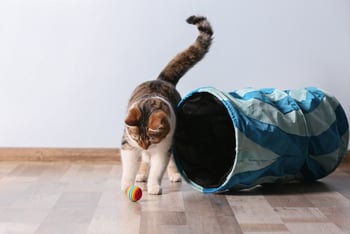 Communication between cats works very well via body language. For example, you can see from a distance how a cat moves its tail. Does it twitch back and forth, is it raised vertically or does it hang down inconspicuously? This can tell the other person a lot about the cat's mood. Usually it is carried inconspicuously downwards with a slight bend, which indicates a normal state. If it wags back and forth, the cat may be in a playful mood or wants attention.
If it tucks its tail between its hind legs, it is afraid. If it is twitching around, the cat is tense, and if it is pointing upwards, this can be both joy and emerging aggression . It always depends on the overall situation to understand the cat's language. This also includes when the cat flaps the tip of its tail. This betrays an inner restlessness. It may be in the middle of an exciting game or on the hunt and is about to pounce.
Eyes and ears in cat language
If you want to understand the language of cats, you have to pay attention to every detail. This includes the position of the ears. They are almost always wide open and pointing upwards in order to pick up sounds perfectly. If the cat hears something, it moves its ears back and forth to identify the direction. Once the sound has been clarified, it relaxes again, otherwise the ears remain in motion. If there is a threat of danger or trouble, it puts its ears back. This not only indicates its mood, but also protects it against possible injury from an attacker.
The eyes should also be taken into account in a cat's mood. If it blinks from time to time and looks around carefree, everything is fine. Half-closed or wide-open eyes, on the other hand, indicate that it feels uncomfortable or perhaps even threatened. This would be consistent with her hunching over and ruffling her fur. If she hisses and raises a front paw, this is clearly the end of the fun.
Conclusion
Cat language is very versatile. If you want to learn it, you need to look very closely. Eyes, ears, tail and posture tell you a lot. In addition, cats like to communicate with us using vocalizations because they know that we react more quickly to them. If you take the time to observe your cat closely - and that's what our cats often do with us - you will soon understand our cats' language better and better.