

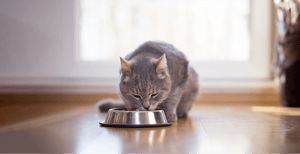
Cats place high demands on their food. Not only the composition of the food, but also its hygienic quality is of great importance. Improper storage could lead to spoilage of the food, attract insects or result in changes in taste. Our tips show you how to store cat food safely.
The perfect pack size saves longer storage times
Depending on how many cats you have at home and whether you offer wet or dry food, you will probably face the problem of correct storage from time to time. It is relatively easy if you use wet food, as this is available in many different sizes, depending on the manufacturer. At animonda, we offer everything from 50 g fresh pouches, 100 g bowls and the popular 200 g cans to large 800 g cans. Many cat owners therefore do not have the problem of storage, because they choose the exact size that corresponds to a meal.
But it's not always that simple. Perhaps your cat's favorite food is not available in the exact packaging size you want or you want to save money and opt for a can of wet food that lasts for two meals a day, for example. The question then arises as to the safest way to store it.
With dry food, you have no choice but to think about the right way to store it anyway, as packaging can last for several weeks. But here too, you have the option of at least choosing a size that will prevent the food from being stored for too long. In any case, it is crucial that the storage is as safe as possible. Our tips will show you what to look out for.
Storing wet food
Wet cat food is available in fresh pouches, small bowls and tins. Fresh pouches and small bowls usually fit exactly for one ration, which is why the question of storage rarely arises. If you do, you canuse a sealing clip for bagsand (soft) silicone fresh-keeping lids for bowls, which are also available in a square shape. In any case, it is important to seal the opened pack as airtight as possible and store it in the fridge.
It is much more common for tins not to be used in one go. What you should not do is leave them open for a few hours. Especially when it is warm, the texture of the food can change quickly. This does not necessarily mean that it will spoil straight away, but it can change its taste, to which cats can react very critically. Imagine a liver sausage that you leave unsealed on the kitchen table for five hours. You will see clear color changes on the top layer, which you can also taste. These changes are mainly due to oxygen and the outside temperature. Air and heat should be kept out as much as possible, which is why it is not enough to push the half-open lid back down. Remove it completely, close the can tightly with a silicone lid and place it in the fridge.
An airtight lid is also important for another reason: cans are usually made of tinplate and coated with tin on the inside to protect against corrosion. Although the body needs a certain amount of tin, too much can lead to gastrointestinal problems, among other things. When exposed to oxygen, tin can increasingly dissolve and get into the food. For this reason, an open tin should always be closed with an optimally fitting lid and stored for a maximum of two days (in the refrigerator).
Tip:
A good alternative to using a lid is to decant the food. Use a glass bowl or plastic box with a tight-fitting lid. This avoids any risk of corrosion. A small disadvantage, however, is that you have to rinse the container thoroughly each time before you can use it again.
Storing dry food
Unopened, both dry food and wet food generally have a shelf life of over a year. The reason for this is that both are sealed airtight. As soon as you open a bag of dry food, air enters, which slowly but surely reduces the shelf life. If you open a large bag every day and fill it with the daily ration, this process is accelerated. It is therefore advisable to transfer a portion into a larger container that can be sealed airtight. The bag should be resealed immediately (with as little air inclusion as possible) and should never be stored in a place where the sun occasionally shines on it. It should be stored in a cool, dry and dark place.
If you accidentally open the packet of dry food too wide or feel that it can no longer be closed perfectly, you should transfer the entire contents to containers with a screw cap or well-fitting plastic lid. The advantage of this is also that the cat does not have the opportunity to open a food bag with its claws and help itself to it.
If you store dry food for too long and not properly, there are the following risks:
- The food becomes soft
The crunchiness of the food is increasingly lost. Some cats don't care about this, others disdain it. - Risk of spoilage
Dry food is packaged in as sterile an environment as possible. As soon as it is opened, oxygen penetrates into it, causing oxidation to begin. Any added antioxidants provide a certain degree of protection, but a process is still set in motion. This affects the fats, for example, with which dry food is often sprayed. Over time, these can become rancid and lead to spoilage of the food. - Molds and food mites
If stored improperly or for too long, storage mites or other pests can settle in and mold can develop. These can lead to health problems and allergic reactions.
Ideally, you should not buy dry food bags that keep the food for a long period of time. It's better to spend a few euros more and avoid the risk of the food going bad. Occasionally refill a supply from a larger bag and rinse the container with hot water every time it is empty. Under no circumstances should you fill it up again and again, but use it up completely and clean it before you put in a new load.