

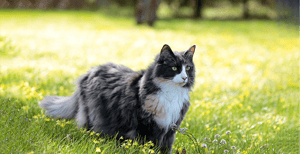
The Norwegian Forest Cat is one of the most impressive cat breeds. It can reach a length of 130 centimeters. This makes it a very self-confident cat, which is nevertheless playful, talkative and in need of affection.
Profile of the Norwegian Forest Cat
- Size large
- Weight cat: approx. 5.5 kg, male cat: approx. 7.5 kg
- Origin Scandinavia
- Build long, strong
- Coat length semi-long
- Coat color all
- Coat care medium
- Behavior talkative, playful
- Character self-confident, calm
Appearance and character of the Norwegian Forest Cat
With a length of up to 130 centimeters, the Norwegian Forest Cat is one of the largest cat breeds in the world. Their body is long and strong and enables them to make enormous leaps. Their hind legs are slightly longer than their front legs and end in large round paws. Their bushy tail and the lynx-like tufts of hair on their ears are striking. Their lush fur also gives them an imposing appearance.
Officially, they are classified as semi-longhaired cats, but their outer coat is strikingly long. It consists of coarse, shiny guard hairs that provide perfect weather protection. Underneath is a very woolly undercoat. When the Norwegian Forest Cat has a full coat in winter, it has an extra thick coat on its neck, chest and hind legs. As with the eyes, the coat may be of any color. Only pointed markings are excluded in the breed standard.
As is often the case with large dog breeds, the Norwegian Forest Cat seems to be aware of its size. At least it seems as if nothing can upset them so quickly and they always seem to have everything under control. It is self-confident, robust and fearless. She is therefore also suitable as a family cat when things get a little more turbulent in everyday life. When in doubt, she knows how to defend herself or simply retreats to a place where she can have some peace and quiet. But she can't stand it for too long because she is curious, playful and talkative. She loves chatting with her peers or her beloved two-legged friends. And of course she also enjoys cuddles together, because she is very sociable.
Norwegian Forest Cat: keeping and care
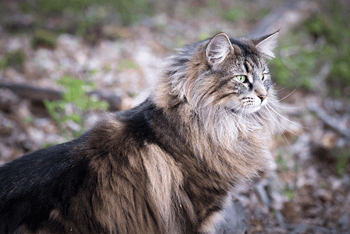 Keeping a Norwegian Forest Cat is uncomplicated. It is adaptable, has no special requirements and is generally a rather reserved companion. However, they can sometimes be quite temperamental and full of energy. This is when it becomes clear whether the scratching post that is hopefully available in the household is worthy of them. If two adult cats are chasing each other, the scratching post should not only be stable but also well secured. Scratching posts that are as high as the ceiling and can be secured at the top are ideal. They are also happy to have cuddly caves, alternative places to lie down and toys. Although it is not one of the cat breeds that want to miss out on a single round of play, it does not want to do without it. Despite their size, they are nimble and agile.
They do not necessarily need to go outside, but they have no objections to it. Perhaps they can be offered a cat-safe balcony or garden. However, with enough variety in their lives, Norwegian Forest Cats can easily do without outings. Another conspecific is beneficial for this. Life is simply more fun in pairs. And no two-legged friend need fear that this will mean no more cuddles together.
When it comes to grooming a Norwegian Forest cat, you should be aware that it has a very thick coat, especially in winter. To avoid tangles, it should be combed about twice a week. If the coat is about to change, daily combing is recommended, as the cat loses an enormous amount of hair. If it swallows too much, there is a risk of gastritis. You should therefore provide your cat with sufficient support during the shedding period.
Nutrition
Whether kitten, adult cat or senior - the food for a Norwegian Forest cat should always be of high quality and adapted to its age. Cats are carnivores by nature, so the cat food should contain a high proportion of meaty ingredients. Sugar, flavor enhancers and artificial colors and preservatives should not be added to the food.
animonda offers the right food for every stage of your cat's life. Choose between kitten, adult and senior food. The products are specially formulated to meet the particular nutritional requirements of the different life stages of cats. This creates the best conditions for a healthy and long cat life.
Health of the Norwegian Forest Cat
Norwegian Forest Cats have a life expectancy of around 15 years. This is a good average, which speaks for a healthy and robust breed. However, this does not protect them from any hereditary diseases that may occur. To avoid these as far as possible, responsible breeders have their cats tested by a vet. One of these diseases is hypertrophic cardiomyopathy (HCM). This is a disease of the heart muscle that causes the interior of the heart to become increasingly smaller. This can lead to shortness of breath in the cat.
The occasional occurrence of hereditary glycogen storage disease is also known. This can result in kittens being born dead or dying a short time later. Problems can also occur in connection with the coat color white. Under no circumstances should two white animals be mated with each other, as there is an increased risk that the offspring will be deaf.
History and breeding
Even if the name sounds as if it is unquestionably a Nordic natural breed, this is still disputed today. It cannot be ruled out that Vikings brought the long-haired cats home with them from the Orient. It is also possible that Angora and Persian cats were crossed in between. Possibly to solve the problem that when occasionally mating with short-haired feral domestic cats, the latter's genes always retained the upper hand in terms of coat length. But the harsh Scandinavian climate has certainly also contributed to the development over the centuries of this large, robust cat breed with its extremely weather-resistant coat. They can easily withstand temperatures of minus 10 degrees.
Whether a natural breed or not, the Norwegians are proud of this cat breed and declared it their national cat in 1972. This has led to increased work on pure breeding. It was only thanks to this effort that the Norwegian Forest Cat was finally recognized by the European umbrella organization Fife in 1977. Since then, it has blossomed and become one of the most popular cat breeds.