

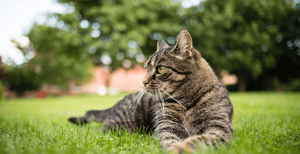
The European Shorthair is the pure breed of our normal domestic cats. As the two often differ only slightly or not at all, there is very little interest in the breed.
European Shorthair profile
- Size medium
- Weight cat: approx. 5 kg, tomcat: approx. 6 kg
- Origin Europe
- Physique robust, strong
- Coat length short, dense
- Coat color all natural colors
- Coat care low
- Behavior active, cuddly
- Character curious, affectionate
Appearance and character of the European Shorthair
If you take five normal domestic cats and five purebred European Shorthairs and ask someone to tell them apart, it would be an almost impossible task. Because unless another purebred cat breed has accidentally crept into a domestic cat, they all look like all the animals we are used to seeing roaming around outside. And this is extremely varied. In principle, almost all colors and patterns are allowed. But there are exceptions. And that is exactly what the European Shorthair is all about.
Their great natural diversity should be preserved so that the same thing doesn't happen as with the British Shorthair. They too were originally normal domestic cats. However, various crossbreeds led to significant changes. This has not happened to us to this day, which is why we have an untouched natural population of domestic cats in Germany. They may have countless colors, markings, markings and spots. But they are not allowed to have points or a particularly fluffy coat, for example, which would indicate cross-breeding with another breed. The breed standard also allows a wide range in size and weight. Even two different eye colors are allowed. Anything that can occur naturally is fine.
There are also often no differences in character between "normal domestic cats" and purebred European Shorthairs (EKH). They are playful, curious, active, cuddly and affectionate. You can expect this from an EKH, but with a domestic cat you can only hope. This is because the European Shorthair always grows up in the care of a family and is therefore familiar with close contact with people right from the start. The situation is different for farm kittens. They may grow up in a barn and be very reserved towards us at first. The risk of them being shy and rather freedom-loving is much higher than with a European Shorthair.
European Shorthair: keeping and care
If you want a domestic cat that is people-oriented and has little interest in roaming around outside, a European Shorthair is the right choice. There is just one problem: many animal shelters and private individuals do not differentiate between the terms domestic cat and European Shorthair. You might think that there are countless purebred animals. However, this is not the case. Often, any cat that does not belong to another breed is simply referred to as a European Shorthair. In principle, this is often true, but the subtle difference as to whether the animals have definitely grown up in human care and no undesirable colors are present or no other breed could have crept in remains unnoticed. Finding a "genuine" European Shorthair breeder in Germany who can prove the pedigree of his animals is a real challenge. But for those who do not want to buy their cat from a breeder, this does not matter. The only thing that matters is that you like the animal's character and appearance.
In principle, keeping a cat is completely uncomplicated. The European Shorthair is a very adaptable breed that would enjoy being kept outdoors, but with enough variety in the household and a playmate, it also has no problem being kept indoors. They are perfect for families.
Grooming a European Shorthair is also easy. As we know from domestic cats, they do most of the grooming themselves. However, it is important to carry out a quick check regularly. If you comb your cat once or twice a week, for example, you can detect parasites or possible skin irritations at an early stage and do something about them. Your cat will also be happy if you give it a helping hand during the shedding period. Then it won't swallow so much hair when being washed.
Nutrition
Whether kitten, adult cat or senior - the food for a European Shorthair should always be of high quality and adapted to its age. Cats are carnivores by nature, so the cat food should contain a high proportion of meaty ingredients. Sugar, flavor enhancers and artificial colors and preservatives should not be added to the food.
animonda offers the right food for every stage of your cat's life. Choose between kitten, adult and senior food. The products are specially formulated to meet the particular nutritional requirements of the different life stages of cats. This creates the best conditions for a healthy and long cat life.
Health of the European Shorthair
European Shorthair cats do not have any noticeable hereditary diseases. They are considered to be very healthy and particularly robust. However, this does not mean that they cannot become ill. To minimize the risk, responsible breeders have all recommended vaccinations and any recommended genetic tests carried out. This reduces the risk of illness, but does not rule it out, which is why an annual health check should be carried out by a vet.
History and breeding
Domestic cats have been around for thousands of years. They were and are welcome lodgers on farms because they keep the mouse population down. The variety among the animals is almost infinite, after all no one pays attention to who mates with whom. This is exactly what many people like. Almost every animal looks different and is a little surprise package. It was the same with the British Shorthair. But breeders realized that the animals sold better if they were fluffier and rounder in appearance and looked more like a cuddly toy. Russian Blue and Persian cats, among others, were therefore crossed in. As a result, today's BKH bears little resemblance to normal domestic cats.
In order to retain all the characteristics of the typical European domestic cat, breeders in various European countries joined forces in the 20th century and developed a standard. In Scandinavia, Denmark and the Czech Republic in particular, there was great interest in officially recognizing the breed. This came about in 1982, when the European umbrella organization FIFé included the breed in its statutes. It reads: "It is assumed that the "ideal" European cat is completely free from crossbreeding with other breeds and does not differ from the European domestic cat."
The plan to formulate a standard for domestic cats across Europe was basically successful. However, as we have a large population of domestic cats in Germany that functions more or less without any particular influences, there is little interest in purebred European Shorthair cats. In Germany, the European Shorthair has not yet been able to establish itself as a pedigree cat and so it is extremely difficult to find breeders who offer a pedigree. But as long as our domestic cats continue to develop naturally, we can cope with this situation.