
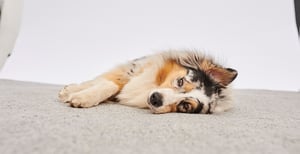
Diarrhea is relatively common in dogs. Mild diarrhea often goes away on its own. As soon as the diarrhea lasts longer than a day, you should take your dog to the vet.
Causes of diarrhea in dogs
Diarrhea is not a disease, but a symptom that can have a variety of causes. Relatively often , diarrhea in dogs is caused by something they have eaten that they cannot tolerate. For example, the ingestion of carrion can lead to diarrhea.
Infections with bacteria, viruses or parasites, such as giardia or worms, canalso cause diarrhea. However, bacteria can also be ingested via the food if it is spoiled and thus cause soft stools.
There are other possible causes of diarrhea:
- Too large a portion of food
- Rapid food changes
- Feed that is too cold
- Food intolerances
- Consumption of food that is incompatible for dogs
- Toxic substances
- Medication that causes diarrhea as a side effect
Finally, diarrhea in dogs can also be caused by stress, but when a dog experiences stress is very individual. Stress factors for the dog can be changes in the household, new situations on a walk or even a car journey.
How does diarrhea manifest itself in dogs?
Dogs' stools are usually well formed. However, if there are problems in the gastrointestinal tract, these can become noticeable through a change in the stool. These changes can be recognized by a reduced water content in the faeces or if there is more water in the faeces. It can then be mushy, in extreme cases even liquid and possibly interspersed with mucus or blood. Defecation is then usually more frequent and is often accompanied by symptoms such as vomiting, abdominal pain and loss of appetite.
If you notice that your four-legged friend wants to go out more often to do his business, you should keep a close eye on him. As soon as he shows you that he wants to defecate, you should be prepared to take him for a walk straight away. The diarrhea causes the dog to lose a lot of fluids. To prevent him from becoming dehydrated, you should always offer him fresh water in small portions so that he can make up for the losses.
When should I take my dog to the vet if he has diarrhea?
In most cases, diarrhea resolves itself within two days. Experienced dog owners know their dogs and can judge quite well whether it is the "usual diarrhea" that afflicts almost every dog from time to time and is no cause for concern or whether there is more to it. If a puppy still has diarrhea after 24 hours, you should definitely visit the vet.
The same applies if there is blood in the stool, the dog also vomits frequently, has a fever of over 40 degrees, seems apathetic or extremely restless. If, on the other hand, your dog's general condition is relatively normal and he is only a little listless, then you can wait and see. In most cases, it helps if the dog is not given any food for 24 to 48 hours so that the intestines can recover. However, it is important that the dog is provided with sufficient fluids in small quantities.
What should I feed my dog with diarrhea?
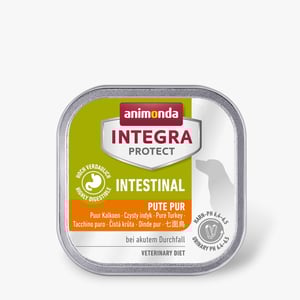
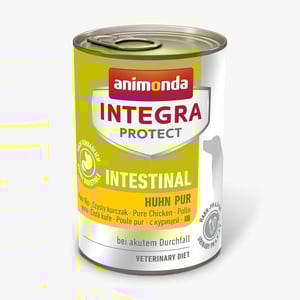
Once the diarrhea has subsided, it is advisable to feed your dog a light diet such as animonda INTEGRA PROTECT Intestinal. This should be fed in small portions.
The special food INTEGRA PROTECT Intestinal has been specially developed for dogs with acute diarrhea. It provides highly digestible animal proteins and well-tolerated rice (carbohydrate source). INTEGRA PROTECT Intestinal contains little fat so as not to burden the stomach. The loss of electrolytes caused by diarrhea is compensated for by the increased amounts of sodium and potassium in the food.
Take your dog to the vet well prepared
If your dog's general condition is poor, do not wait any longer to visit the vet. The same applies if the diarrhea is chronic. It is an advantage if you prepare yourself for the following questions:
- When did the diarrhea start?
- How often does the dog defecate?
- What does the diarrhea look like?
- Does the dog have frequent diarrhea?
- What is the dog eating or has there been a change in food?
- Have there been any particular incidents recently?
- Are other dogs ill that could be contagious?
The vet is always grateful for this information. Depending on the severity of the diarrhea, a fecal and/or blood test can be performed to make a diagnosis and initiate appropriate treatment measures.