

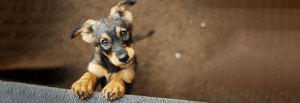
The ears are the dog's second most important sensory organ. Just like the nose, it is a highly sensitive multi-tasking organ. If they are dirty or infected, it is important to clean them and treat them with suitable products.
The ears of our dogs
There are small and large, short and long, pointed and rounded , upright and drooping dog ears. The different shapes are enormous. There are also hairy and almost naked ears, as well as ears that are well hidden or clearly visible from a distance. What they all have in common is that they are clearly superior to our ears. However, not to the same extent.
While large erect ears are the purest satellite dishes, small floppy ears are not quite as powerful. There are no significant differences in the frequency range: regardless of ear shape, dogs can perceive high-pitched sounds up to 45,000 Hz. For us, this stops at around 16,000. This means that for some people, dog whistles can only be heard to a very limited extent, whereas for dogs they are in the medium frequency range. For them it is also no problem to hear the whistling of a mouse.
Special functions of the dog's ears
Dogs can not only hear very soft and very high-pitched sounds, but also the direction. Unlike us, they can turn their ears almost 360 degrees with the help of 17 muscles - and they can do this individually: while one is directed forwards, the other can scan the area behind the dog. This makes three-dimensional hearing possible. This enormous capacity means that dogs are theoretically constantly exposed to sound.
However, there is a trick that prevents this: their sensory cells are not connected directly to the ears, but to the brain via nerve pathways. These can be switched on and off more or less like a light switch. In everyday life, this means that they can block out background noises such as a television or vacuum cleaner. You put your ears on a draught, so to speak, and can therefore relax better.
Impairments for dogs' ears
Dog ears are a "self-cleaning organ". Countless tiny cilia inside the ear ensure the removal of excess earwax. In addition, larger hairs largely prevent the penetration of dirt and dust. Unfortunately, however, self-cleaning does not always work perfectly. Sometimes soil, sand, awns or grass get stuck in the ears . Parasite infestation can also occur, often involving mites. In addition, it is mainly floppy ears that are at risk, where fungi and bacteria multiply easily due to the warm and moist environment.
Symptoms of diseased ears
 It is not uncommon for dogs to scratch themselves. They like to itch here and there. However, if a dog brushes its ears conspicuously often with its front paws or scratches them intensively with its hind paws, this indicates a problem. Even if you cannot actively see the scratching, please check the inside and outside of the ears for signs of scratching.
In these cases, you should take a closer look at the ears. First examine them from the outside to see if, for example, awns have become embedded or a tick has bitten into them. If you can't see anything here, take a look inside the ears in good light. You may be able to see a foreign body there. Also look for changes in color: Black spots, redness, scales or crusts indicate a mite infestation or infection. Another indication may be if the ears smell unpleasant or if the dog is very sensitive to touch.
What to do if your dog's ears are inflamed?
If your dog shows typical signs of ear pain and you are unable to solve the problem yourself, for example by removing a tick, taking out a twig or brushing out sand, you should go to the vet. With the help of appropriate instruments, the vet will be able to find the cause of the ear problems. For example, mites can be clearly identified under the microscope using a swab. It is also possible to determine whether there are foreign bodies in the ear, whether the eardrum is damaged or whether there is an unusual amount of earwax. Depending on what the examination has revealed, the vet will carry out or suggest appropriate treatment.
Ear mites in dogs
If an ear mite infestation has been diagnosed, this is not particularly dangerous but should be treated immediately. The dog is plagued by extreme itching from the bites of the little pests. Allergic reactions and bacterial skin infections can also occur. There is also a high risk of transmission to all other animals with which the dog comes into contact.
There are various remedies available to treat ear mites: First of all, the vet will probably clean the ears. Then a spot-on preparation or an ointment can be used to combat the mites. This is applied directly to the inflamed areas. This usually has to be done over a period of at least three weeks. Any other dogs living in the household should also be treated after consultation with the vet. In addition, do not forget to thoroughly clean all of the dog's lying areas and places where it spends time.
Clean the dog's ears
To prevent ear infections or to help treat them, it may be necessary to clean the ears regularly. Typical household remedies are olive oil and coconut oil, but it is better to use a special ear cleaner. This is dripped directly into the ear and gently massaged in. Most four-legged friends do not find this unpleasant and will put up with it. The dog is then allowed to shake its head extensively, as this removes loose dirt. Finally, you can use a cloth to clean easily accessible areas of the ear from the inside out. Do not use cotton buds, as this could push secretions further in. Once the ears have recovered, the removal of excess earwax will work itself out again.