


Cats change their coat twice a year. Cat owners should support their pets during this process.
What is the purpose of shedding?
When it's cold outside, we put on a warm jacket. If, on the other hand, the temperature is over 30 degrees, we are glad of any item of clothing that we can take off. It's no different for our cats: In the fall, they shed their thin summer coat and put on a winter coat.
As winter draws to a close, the shedding process begins again and they lose their winter coat. This is a difficult time for every cat owner, as thousands and thousands of hairs are spread all over the home, especially between April and October.
Do all cats shed?
Not every cat sheds to the same extent. Cats living in the wild or cats with regular outdoor access have a much more pronounced shedding process than indoor cats. Two factors influence the intensity of shedding. The start of shedding is influenced by the length of daylight. Outdoor cats are aware of this every day, whereas indoor cats are only aware of the length of daylight to a limited extent, as the light is switched on as soon as it gets dark outside.
The second reason for the change of coat is the outside temperature. For indoor cats, these hardly play a role, at most when they make occasional excursions onto a balcony. If they are too cold, they quickly retreat back into the warm. Cats, on the other hand, who do not want to miss out on extended tours through their territory, clearly feel both cold and hot temperatures and react to them by adapting their fur. They are generally the most subject to shedding, whereas many indoor cats shed almost all year round and only show a slight increase in spring and autumn.
How does the shedding process work?
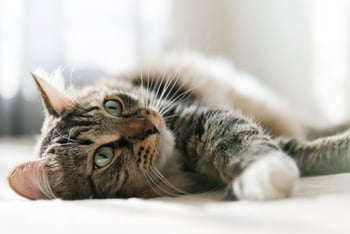 In the fall, the coat becomes thicker and longer to protect the cat from the cold, while in the spring the top coat becomes shorter and the cat loses its thick woolly hair. A cat's coat change takes about 6-8 weeks.
Each time the coat is shed, space has to be made for the new coat, which is why the old hair falls out. A new hair root then forms there, the hair grows and is supplied with nutrients. Once it has reached a certain length, growth stops.
This is followed by a transitional stage and the so-called resting phase, in which the hair no longer receives nutrients but is still firmly anchored. It slowly dies and eventually falls out, allowing the cycle to start all over again.
Dangers of shedding in cats
Normally, the shedding process takes care of itself. But this is not a matter of course! Long-haired cats in particular run the risk of swallowing too many hairs when grooming, which could lead to inflammation of the stomach lining or even an intestinal blockage. To control this risk, many cats regularly regurgitate undigested hairballs. Therefore, provide your cat with cat grass, especially during the shedding period - the plant fibers support your cat during this process.
Support during shedding
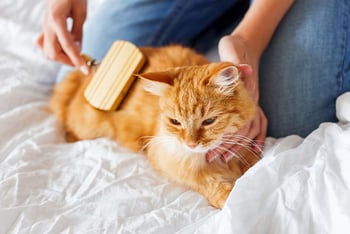
Cats are known to spend a lot of time grooming. While they lick their fur, they not only clean it, but fine re-hooks on the tongue ensure that loose hairs are removed and remain there. They are then inevitably swallowed. To keep the amount as low as possible, cats should definitely be supported in grooming.
This is especially true for long-haired indoor cats. Unlike outdoor cats, they do not roam through tall grass or bushes, which means that the cat loses a certain amount of hair. In addition, although they do not generally have a higher number of hairs, their length means that they have a significantly greater mass of hair. Long-haired cats should therefore be combed or brushed daily.
A nutritious diet is also essential for a healthy coat. In particular, omega-3 and omega-6 fatty acids, proteins, zinc, copper and vitamins A, B and E ensure that your cat's coat shines from the inside out. Our tip: When feeding your cat, make sure it has a balanced diet by choosing a complete food such as animonda Carny and animonda Vom Feinsten.
Brush your cat properly
Always brush in the direction of coat growth. Brushing in the opposite direction could be uncomfortable for the cat. It is best to start at the head. Depending on the cat's coat structure, it may make sense to use different combs or brushes in order to optimally groom both the undercoat and the top coat. For thin coats in particular, it is advisable to use combs or brushes that are not too "sharp" but have rounded tips. For short-haired cats, there is still the option of simply using a grooming glove. This is not enough for long-haired cats: they should therefore be accustomed to being groomed by humans from an early age so that this becomes a completely normal ritual.
No matter how much you help your cat to shed, countless cat hairs are still spread around the home, especially during the shedding period. Only regular vacuuming can help here. A special attachment with a rotating brush that picks up hair from the floor better can be helpful. A high suction power is also an advantage. Many cat owners also use lint brushes to remove pet hair from clothing, for example. Adhesive brushes or the use of adhesive tape wrapped around the hand also help in this respect. Ultimately, however, one thing is needed above all else - patience - because in a few weeks the spook will fortunately be over.