

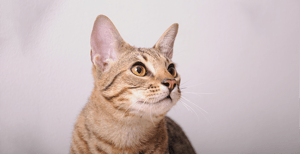
This beautiful cat breed is characterized by its spots. They give the Ocicat a wild look. But don't worry, at home it is very affectionate, cuddly and lovable.
Ocicat profile
- Size medium
- Weight cat: approx. 4.5 kg, tomcat: approx. 5.5 kg
- Origin USA
- Physique athletic, graceful
- Coat length short, smooth
- Coat color from cream to black
- Coat grooming easy
- Behavior playful, talkative
- Character affectionate, balanced
Appearance and character of the Ocicat
The Ocicat is one of the few cat breeds that are spotted. The breed standard refers to dark spots on a light background. These should extend from the shoulders to the rump and as far down the legs as possible. As many interrupted rings as possible are desired on the throat and lower legs and the tip of the tail should always be dark. The coat itself is short, smooth and silky in texture with a glossy sheen. 12 different colors are permitted: fawn, cinnamon, lavender, chocolate, blue and black - each pure or as a silver variant.
The body of the Ocicat is medium to large in size, athletically built, muscular and at the same time supple and elegant. It is relatively long and should never appear clumsy. The eyes are large and may be any color except blue. Ear tufts are welcome, but are not required by the breed standard. Pale, blurred markings are not desirable.
Not only the appearance of the Ocicat is impressive, but also its character. It is an interesting mixture that has to do with its origins. On the one hand, the Abyssinian cat, which is known for its playfulness, balance and resistance to stress. On the other hand, it also has traits of the Siamese, which is affectionate, talkative and playful. The result is a cat breed with a very versatile character. Anyone interested in an Ocicat should therefore ask the breeder what the character of his kittens is like. At the age of a few weeks, it is often possible to tell whether the kitten is a little bully or a reserved animal. However, you can't really go wrong, as they are all considered to be very sociable and affectionate. They are therefore also suitable for life in a family with children.
Ocicat cat: keeping and care
An Ocicat is a very pleasant companion. On the one hand, it is human-oriented and affectionate. These are perfect conditions for cuddling together. On the other hand, it is a little tomboy. Things can get pretty fast-paced with her. So variety is guaranteed. And she needs it too. Boredom is not for an Ocicat in the long term. That's why it needs people on the one hand and an exciting environment or even a conspecific on the other. Cats prefer to live in pairs, so they don't mind so much if none of their two-legged friends are at home. It is also beneficial to provide interesting cat toys and a varied scratching post. If the human also plans enough time for cuddles every day, the world will be in perfect order for the Ocicat.
If you are looking for an easy-care cat, you have found it in the Ocicat. This beautiful shorthair cat requires virtually no grooming. This is not only due to its short hair, but also to its almost non-existent undercoat. All you need to do is run a brush, comb or grooming glove over the coat from time to time to remove dead hair.
Nutrition
Whether a kitten, adult cat or senior - the food for an Ocicat should always be of high quality and adapted to its age. Cats are carnivores by nature, so the cat food should contain a high proportion of meaty ingredients. Sugar, flavor enhancers and artificial colors and preservatives should not be added to the food.
animonda offers the right food for every stage of your cat's life. Choose between kitten, adult and senior food. The products are specially formulated to meet the particular nutritional requirements of the different life stages of cats. This creates the best conditions for a healthy and long cat life.
Ocicat health
Little is known about typical diseases in the Ocicat. They are considered to be quite healthy and robust, as evidenced by their average age of 15 years. As the gene pool is small, problems with inbreeding cannot be ruled out. These can include the heart disease HCM (hypertrophic cardiomyopathy) and the eye disease PRA (progressive retinal atrophy). Pyruvate kinase deficiency, a special type of anemia, is also occasionally reported. It is advantageous to purchase an Ocicat only from a reputable breeder who minimizes the risk of disease through preliminary examinations and genetic testing.
History and breeding
The origin of the Ocicat is very unusual: in 1964, cat breeder Virginia Daly had an idea. She wanted to mate one of her Abyssinian tomcats with a Siamese cat. The plan was to get a Siamese with Abyssinian markings. The result was indeed Aby Point kittens. However, one kitten was very different from the others. It had an unusual golden spotted coat, which was not at all what she had in mind. Virginia Daly decided to neuter little Tonga and sold him to a medical student for 10 dollars.
Because of his beautiful pattern, a regional newspaper published a photo of Tonga. This caught the eye of geneticist Dr. Clyde Keeler. He wrote to Mrs. Daly asking if she would like to start her own breeding program with Tonga and his mother. This was no longer possible due to the neutering, but the cat breeder was interested in the idea and again attempted to mate a Siamese with an Abyssinian. The first attempt failed, but the second resulted in another spotted specimen. The breeding of the Ocicat began with this one.
A name for the new breed was quickly found, as the spotted animals reminded Virginia Daly's daughter of the Ocelot, a South American cat of prey. A mix of the two words Ocelot and Cat resulted in Ocicat, which was to be the chosen name of the cat breed from then on. Mainly Siamese and Abyssinian cats were bred, occasionally American Shorthairs were also involved. This was done to increase the variety of colors. Virgina Daly had probably wished for success a little earlier, but in the end she achieved her goal: in 1987 the breed was officially recognized in the USA, followed by the European umbrella organization FIFe in 1992. Despite its fascinating look, the Ocicat has not become very well known. It is one of the rare cat breeds that are relatively difficult to obtain.